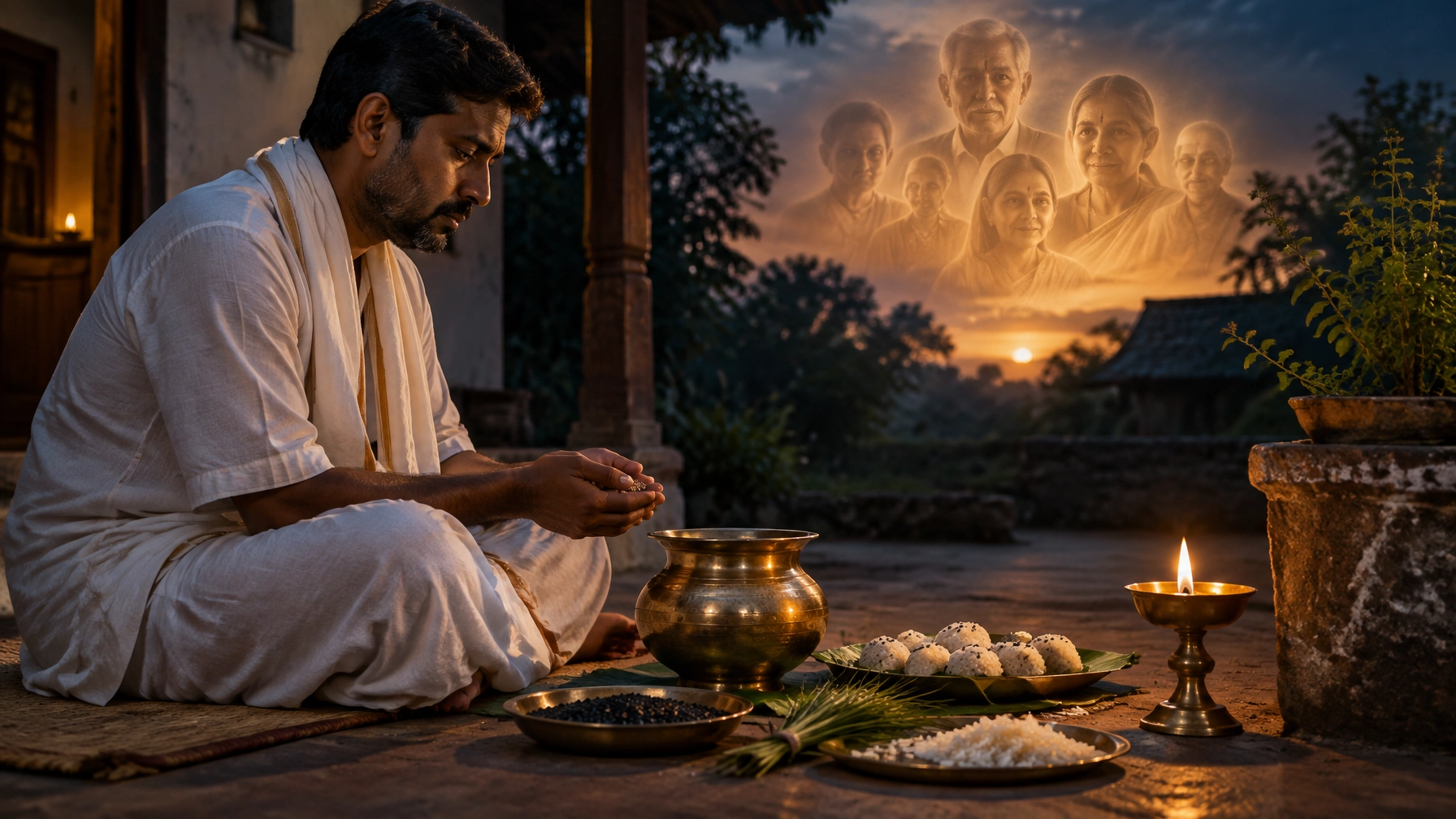
Every Hindu in Sanatana Dharma worships the five devatas, the pancha devatas, in primordial worship: Bhagavan Vinayaka in the form of Ganesha, Bhagavan Shiva in the form of Rudra, Bhagavan Vishnu, Mahadevi Shakti in her different swarupas, and the visible form of Aditya, Surya Bhagavan.
But there is also a set of devatas who belong to us alone. They can be worshipped only by the individual or by that individual’s family. These are the pitru devatas, the ancestors.
The fifteen days of Pitru Paksha are a dedicated portal and a reminder to each one of us to dedicate ourselves to the sadhana, worship, and puja of our pitru devatas. They are dependent upon us. Through our acts and karmas, they move ahead in their lineage and continue their journey toward mukti.

The Three Debts
In Sanatana Dharma, every individual is born with three debts in life: deva rin, pitru rin, and rishi rin.
The debt toward the pitru devatas, the ancestors, is extremely important. It is part of the condition with which each of us takes birth, and this debt must be settled before we die, before we leave this physical body.
Pitru rin is not an idea that belongs only to the past. It is a duty carried by the living toward those who came before them.
The Lokas and the Journey of the Ancestors
Understand that there is a plane in Bhuloka, which is where we live. There is also a plane in Swargaloka, which is the destination toward which our ancestors aim to reach. In between is Pitruloka.
The journey from Bhuloka to Pitruloka, and from Pitruloka to Swargaloka, is something our ancestors have to travel. In Hinduism, death does not mean that the journey is complete. Even after death, there is a journey that must be completed.
For this journey, our ancestors are dependent upon us. This is essentially the concept of pitru rin, the debt toward our ancestors.
Pretaloka and Those Who Become Stuck
It is not given that every ancestor will reach Pitruloka.
If the shraddha karma is not performed well, if the pitru rituals are not performed correctly, if the pitrus are disrespected, or if they are not taken care of properly by the family, they may remain stuck. If the elders are not respected in the family, if the women are not respected in the family, or if someone died a very painful death, these and other causes can produce pitru dosha.
Such ancestors remain in the realm of Pretaloka. They do not even reach Pitruloka.
Once they reach Pitruloka, the food that we give here in the form of annadan becomes their own food. The pinda that we make becomes part of their larger soul body. This helps them continue their journey toward Swargaloka, where they seek to reach.
The fifteen days of Pitru Paksha are therefore a dedicated portal for us. They remind us to fulfil this debt toward our ancestors and help ensure that they reach the highest state possible.
Karna and the Food He Had Not Given
There is a story in the Mahabharata about Karna, who was known as Dhanveer because of his virtuous and generous nature.
After Karna died, he had to return to Pitruloka because, when he was in Swargaloka, he did not receive any food to eat. Throughout his life, he had donated only gold.
This expresses a principle in our dharma: after death, we receive what we ourselves have donated with our own right hand.
Karna had given gold, and therefore gold was available to him. But he had not given food. For this reason, he had to return during this period of fifteen days and perform annadan so that he could return and have food.
In the same way, every ritual we perform during these fifteen days reaches our ancestors. Through their blessings, not only we but also the coming generations thrive and move ahead in their respective journeys of life.
Pitru Dosha
This entire period leading up to Mahalaya becomes significant for removing or taking care of one of the most serious doshas present in the times of Kali Yuga: pitru dosha.
Pitru dosha is difficult to identify because it is not always reflected in an individual’s horoscope. There are, however, symptoms and circumstances that may indicate its presence. These can include:
- Hair appearing in food again and again.
- Constant difficulty in conceiving.
- Difficulties concerning a child born into the family.
- Cognitive difficulties, brain-related difficulties, or mental disorders.
- Constant financial hurdles.
- Repeated expenditure on food, medicines, and hospitals.
- Constant legal hurdles and battles.
These are signs that a person may be afflicted with pitru dosha.
But pitru dosha is also one of the easiest doshas to remove. Ancestors do not have much expectation from us. They expect shraddha, tarpan, annadan, and pindadan because they are dependent upon us.
If these are not performed, they remind us of the duty in different ways: through visions, through dreams, and through flashes. Many people encounter their ancestors in dreams along with difficulties that continue to arise in their lives.
When a person begins looking for solutions, it may eventually come to their ears that pitru dosha is present. In this way, the ancestors remind the living of the duty and karma that only they can perform, so that the ancestors may reach the highest state of pitru mukti.
Who Is Likely to Remain in Pretaloka?
Not every ancestor reaches Pitruloka. Many remain stuck in Pretaloka.
Those who had a prolonged period of sickness in a hospital or who died in a hospital are likely to remain there. Those who died an unnatural death, including death by drowning, suicide, or accident, are more likely to remain stuck in Pretaloka.
Those who were violated, who suffered within the family, who were mentally harassed, or who were disrespected may also remain there. Their souls do not attain that state of mukti.
Kashi and Gaya
There are certain kshetras that become sacred portals for ensuring mukti for such souls. Kashi and Gaya are among them.
In Kashi, there is the Pishach Mochan Kund, where photographs and name-slips of ancestors are fixed with nails.
The Skanda Purana mentions that offering one tila tarpan in Kashi is equivalent to offering ten thousand tila tarpans elsewhere.
In Gaya, the Skanda Purana says that one is not an able son if one does not come to perform shraddha for one’s parents or ancestors there. The mukti of the individual himself is dependent upon whether he has gone to Gaya and performed shraddha for them.
A small act of annadan in a kshetra such as Kashi, such as donating food to one sannyasi, is equivalent to donating food to ten crore sannyasis elsewhere.
The shastras further mention that even if a person says the word Kashi from their mouth, their ancestors flock to Kashi in anticipation of the shraddha dharma or annadan they expect to receive from the coming lineage. If it is not performed, they return disappointed.
The Observances of Pitru Paksha
During Pitru Paksha, there are certain practices that every Hindu should follow.
Do not cut your nails during this period. If your parents are no longer alive, try to avoid shaving, using oil, and using shampoo. Try also to avoid cutting your hair.
Avoid eating onion and garlic. Pitru puja and pitru sadhana cannot be performed while eating tamasic bhojan. Sattvic bhojan is the way.
Feed animals and birds. Cooked food may be kept at home and given to a cow, dogs, monkeys, or crows, who are the vahanas of the ancestors. Doing anything for them is helpful.
Lighting diyas just outside the doorstep during these fifteen days is also a puja, an act of worship toward the ancestors.

Simple Rituals for the Ancestors
Simple rituals such as tarpan and pindadan, which are performed for the mukti of the three generations, can be helpful.
Through these practices, you help your ancestors in their journey, take care of your pitru rin, and take care of pitru dosha. You utilize the fifteen days by remembering your ancestors and honouring their memory and legacy.
Any small act of kindness also goes a long way in resolving pitru dosha and giving rightful dedication to the ancestors.
Many pitru karmas depend upon vaidyas, purohits, and shastris. But certain sadhanas can also be performed during these fifteen days. They can be enlightening for you and bring the grace and blessings of your ancestors.
Tila Tarpan
Tila tarpan is performed by mixing milk with water and black sesame seeds. Take this mixture in the right hand along with some kusha grass and offer it into a plate while chanting the mantra.
This is one of the simple acts through which remembrance becomes offering and duty becomes worship.
The Fifteen-Day Sankalpa
A sankalpa may be taken across the fifteen days.
Take black sesame seeds and think of your own name and the names of the ancestors for whom you wish to dedicate this sadhana. Over the period of fifteen days, take the sankalpa to perform mantra japa every day: either three malas, five malas, or fifteen malas.
At the end of the period, complete this pitru sankalpa by performing annadan on Mahalaya Amavasya.
Remember your ancestors. Honour them. Honour their memory and their legacy. Let every small act of kindness be offered in their name.